

Cutting angle adjustment range is a crucial parameter in the performance of a fiber cutter. As a leading supplier of high - quality fiber cutters, we understand the significance of this feature and its impact on various fiber - optic applications. In this blog, we will delve into what the cutting angle adjustment range of a fiber cutter is, why it matters, and how our products stand out in this regard.
Understanding the Cutting Angle Adjustment Range
The cutting angle adjustment range refers to the span of angles within which a fiber cutter can be set to cut optical fibers. Typically, in the context of fiber - optic connections, a perpendicular (90 - degree) cut is the most common requirement. This is because a 90 - degree cut provides the best surface for splicing or terminating fibers, minimizing signal loss and ensuring optimal light transmission.
However, there are situations where non - perpendicular cuts are necessary. For example, in some specialized fiber - optic sensors, a specific non - 90 - degree cutting angle can be used to achieve certain optical effects. The cutting angle adjustment range allows users to customize the cut according to their specific application needs.
Most standard fiber cutters on the market offer a limited cutting angle adjustment range, usually centered around the 90 - degree mark. A common range might be from 88 degrees to 92 degrees. This small range provides some flexibility to accommodate minor variations in the installation environment or to correct for slight misalignments in the fiber assembly.
But for more advanced and specialized applications, a wider cutting angle adjustment range may be required. For instance, in some military or aerospace fiber - optic systems, where complex optical geometries are involved, a fiber cutter with a range of 80 degrees to 100 degrees or even wider could be necessary.
Why the Cutting Angle Adjustment Range Matters
The importance of the cutting angle adjustment range lies in its impact on the overall performance of fiber - optic networks.
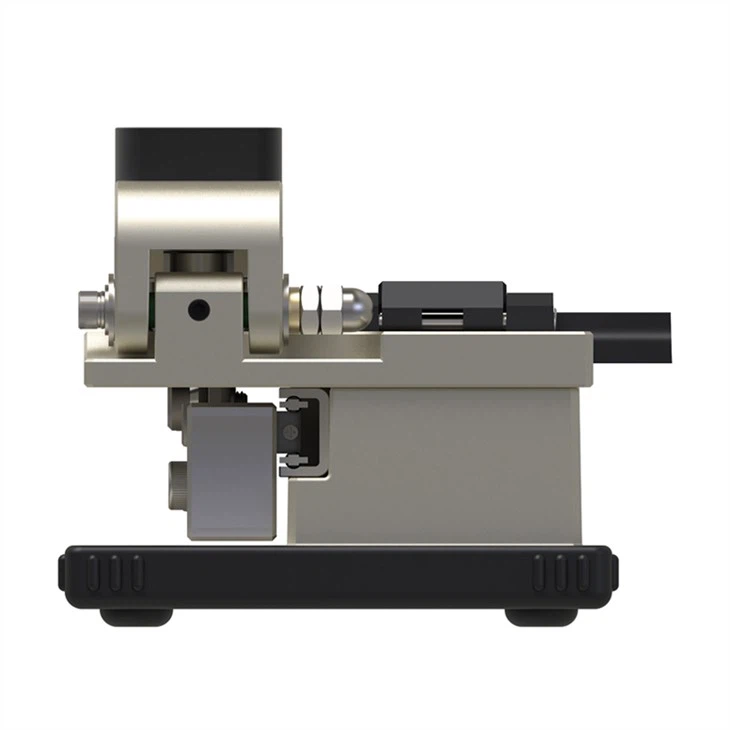

Signal Loss: A precise cutting angle is essential for minimizing signal loss. When fibers are spliced or terminated, any deviation from the optimal cutting angle can lead to increased reflection and scattering of light at the interface, resulting in signal attenuation. By having a well - calibrated and adjustable cutting angle, users can ensure that the light travels smoothly through the fiber connection, maintaining high - quality signal transmission.
Compatibility: Different fiber - optic components and systems may have specific requirements for the cutting angle. For example, some fusion splicers are designed to work best with fibers that have a particular cutting angle. By being able to adjust the cutting angle of the fiber cutter, users can ensure compatibility between different components in the network, reducing the risk of connection failures.
Versatility: A wider cutting angle adjustment range allows the fiber cutter to be used in a broader range of applications. Whether it's for telecommunications, data centers, or industrial automation, a versatile fiber cutter can adapt to different project requirements, making it a more valuable asset for users.
Our Fiber Cutters and Their Cutting Angle Adjustment Ranges
As a trusted supplier of fiber cutters, we offer a diverse range of products with different cutting angle adjustment capabilities to meet the needs of various customers.
Our entry - level Fiber Optic Cleaver provides a standard cutting angle adjustment range of 88 degrees to 92 degrees. This range is suitable for most general - purpose fiber - optic installations, such as home broadband networks and small - scale business LANs. It offers a good balance between precision and cost - effectiveness, making it an ideal choice for budget - conscious customers.
For customers who require higher precision and a wider range of applications, our High Precision Fiber Optic Cleaver is the perfect solution. It features a cutting angle adjustment range of 85 degrees to 95 degrees, allowing for more flexibility in handling complex fiber - optic projects. This high - end cleaver is equipped with advanced calibration mechanisms and high - quality cutting blades, ensuring consistent and accurate cuts across the entire adjustment range.
In addition, our Cleaver Optical Fiber is designed for the most demanding applications, such as research laboratories and high - speed data transmission networks. It offers an extended cutting angle adjustment range of 80 degrees to 100 degrees, providing unparalleled versatility for the most challenging fiber - optic tasks.
Quality Assurance in Cutting Angle Adjustment
We understand that the accuracy of the cutting angle adjustment is of utmost importance. That's why we have implemented a rigorous quality control process in the manufacturing of our fiber cutters.
All our cutting blades are made from high - quality materials and undergo precision grinding to ensure a sharp and consistent cutting edge. The angle adjustment mechanisms are carefully calibrated using state - of - the - art equipment to guarantee accurate and repeatable angle settings.
Before leaving our factory, each fiber cutter undergoes a series of strict tests to verify its cutting angle adjustment accuracy and overall performance. We also provide detailed user manuals and calibration guides to help our customers make the most of the cutting angle adjustment feature and ensure optimal results in their fiber - optic projects.
Contact Us for Your Fiber Cutter Needs
If you are in the market for a high - quality fiber cutter with a suitable cutting angle adjustment range, look no further. Our team of experts is ready to assist you in choosing the right product for your specific requirements. Whether you are a telecommunications engineer, a data center technician, or a researcher in the field of fiber optics, we have the experience and the products to meet your needs.
Contact us today to start a discussion about your fiber - optic projects and explore how our fiber cutters can enhance your workflow and improve the performance of your networks.
References
- "Fiber Optic Communication Technology" by John C. Palais
- "Optical Fiber Splicing and Termination" by Richard Chomycz


